
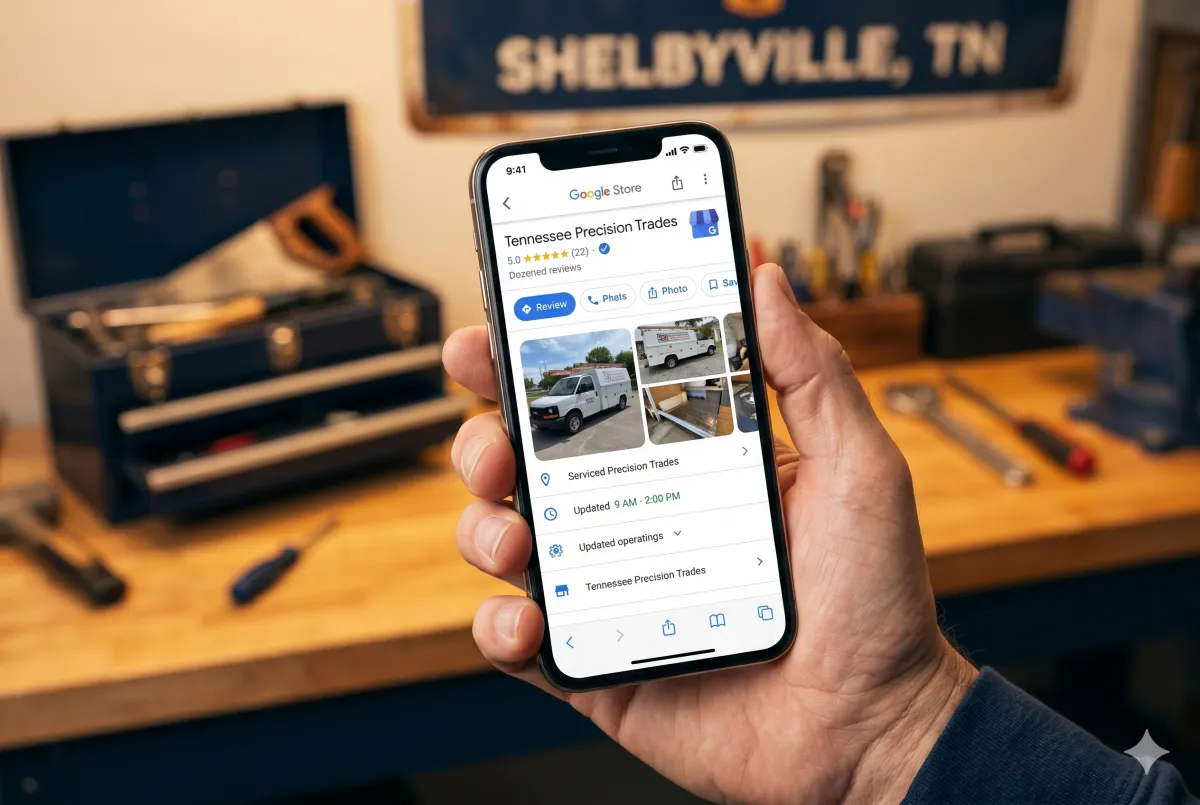
Your Google Business Profile Is the Most Valuable Digital Asset Your Business Owns — Here's How to Treat It That Way
Your Google Business Profile Is the Most Valuable Digital Asset Your Business Owns — Here's How to Treat It That Way
By Steve Cory | Ignite Tennessee | Shelbyville, Tennessee
Answer this honestly: when did you last update your Google Business Profile?
If the answer is "when I set it up" — or if you're not entirely sure anyone ever fully set it up — this post is going to be one of the most important things you read this year.
Because your Google Business Profile isn't just a listing on Google Maps. In 2026 it is the primary document AI uses to decide whether your business is real, trustworthy, and worth recommending to a customer.
Not your website. Not your Facebook page. Not your years in business or your stellar reputation in the community. Your GBP. That one profile — which you can edit right now for free — is doing more to determine whether you show up in AI-generated recommendations than almost anything else in your entire digital footprint.
And most Middle Tennessee businesses are leaving it on autopilot while their competitors quietly pull ahead.
What Your GBP Actually Does in 2026
Your Google Business Profile serves two audiences simultaneously, and most business owners only think about one of them.
The first audience is human customers — the people who find your listing on Google Maps, read your reviews, check your hours, look at your photos, and decide whether to call you. That part you probably already understand.
The second audience is AI. ChatGPT, Google's own AI Overview, Apple Intelligence, Siri, Perplexity — every AI engine that a customer might use to ask "who's the best [business type] near me" is reading your GBP as part of how it forms its answer.
AI reads your profile the way a skeptical journalist would. It's looking for evidence that you are who you say you are. It's verifying that your business is real, operating, and current. It's assessing your reputation based on review volume, recency, and content. It's noting whether you've been active recently — or whether your last post was eighteen months ago and your photos are from a building you moved out of.
Every element of your GBP is a signal. And every neglected element is a signal working against you.
The Eight Elements of a GBP That AI Takes Seriously
Walk through your profile right now — you can access it by Googling your business name while logged into the associated Google account — and check each of these honestly.
Business name. It should be your real business name and nothing more. No keyword stuffing. No city names added in. No "Best HVAC in Murfreesboro" appended to your actual name. Google penalizes this practice and AI reads keyword-stuffed names as a trust negative. Your name is your name.
Address and service area. If you go to your customers — contractors, mobile services, home service businesses — set your service area by city and county rather than showing a home address. Make sure your service area reflects every Middle Tennessee community you actually serve. If you work in Murfreesboro, Smyrna, La Vergne, Christiana, and Rockvale, every one of those should be listed.
Phone number. Use the number customers actually reach you at. This is one of the three NAP fields — Name, Address, Phone — that AI cross-references across dozens of sources to verify your business identity. It needs to match everywhere exactly.
Business hours. They should be current. Including holiday hours. There is almost nothing that destroys a customer relationship faster than arriving at a business that Google said was open. AI reads outdated hours as a signal that your information isn't being actively maintained.
Business description. This is 750 characters to tell Google and AI exactly what your business does, where you do it, and who you serve. Most profiles leave this vague or completely generic. Write it specifically. Name your services. Name the cities and counties you serve. Use the natural language a customer would actually use to describe what you do. This is one of the primary fields AI reads to match your business to specific search queries.
Photos. Google's own research shows businesses with more than 100 photos receive significantly more calls and direction requests. You don't need a professional photographer. You need a phone and a habit. Real photos of your work, your team, your truck, your location — uploaded consistently. Over six months you'll have a profile that looks alive and credible to both customers and every AI engine reading it.
Reviews. Volume matters. Recency matters. The content of the reviews matters. And your responses matter. Every unanswered review is a missed signal. Every specific, detailed review that mentions your services and your city by name is an AI trust signal being logged in your favor. A dedicated post on reviews is coming — but know for now that your review profile is one of the heaviest signals AI weights in any local recommendation.
Posts. This is where most businesses fall furthest behind. GBP posts are short updates — 100 to 300 words, one image, one call to action — that appear on your profile and tell Google and AI that your business is currently active. One post per week is the threshold that separates active profiles from inactive ones. The exact rotation is below.
The Weekly Posting Rotation That Separates Visible Businesses From Invisible Ones
One post per week. That's the entire commitment. And most of your competitors aren't doing it at all.
Here's a four-week rotation that works for any Middle Tennessee service business regardless of industry:
Week one — The Recent Win. A job you just completed, a problem you solved, a project you're proud of. One real photo. Two or three sentences. Include the city name naturally. "We just wrapped a full roof replacement for a homeowner in Christiana this week. If your roof has been a concern heading into storm season, give us a call." That city name in the post is a geographic signal AI reads and logs. You're not just posting for customer engagement — you're building a pattern of location-specific activity that AI associates with your business operating in that area.
Week two — The Helpful Tip. One genuinely useful piece of information relevant to your trade or service. Not a pitch. Actual value. Something a homeowner or business owner in Murfreesboro, Smyrna, or Woodbury would find practically useful. This is the kind of content AI indexes and associates with your expertise in your specific service area.
Week three — The Social Proof Post. Pull language from a recent Google review and share it as a post. "A customer in Smyrna told us we showed up on time, explained every step before we started, and left the site cleaner than we found it. That's the standard we hold ourselves to on every call." The authenticity is the signal — and it models for other customers what a good review of your business looks like.
Week four — The Business or Community Post. Something about your team, a community event you're supporting, a seasonal offer, or an update from the business. Anything that signals you are a real, human, locally connected business operating in Middle Tennessee.
That rotation executed consistently for six months will outperform most of your direct competitors in this market. Because most of them are posting nothing.
The Photos Problem Most Business Owners Don't Realize They Have
Pull up your GBP right now and count your photos honestly.
If you have fewer than twenty, you have work to do. If the most recent ones are from more than a year ago, you have work to do. If there are no photos of actual work — no jobs in progress, no finished projects, no evidence of what you do in the field — you have meaningful work to do.
The fix is simple even if it takes time. Take ten photos this week of your work, your team, and your location. Upload them today. Then build the habit of photographing every notable job before you leave the site. One good photo per job, uploaded the same day. Over six months you'll have a profile that looks alive, credible, and current to both customers and every AI engine reading it.
The One-Sentence Standard for Your GBP
If a potential customer — or an AI engine — looked at your Google Business Profile right now with no prior knowledge of your business, would they conclude that you are an active, trustworthy, well-established business that clearly serves the Middle Tennessee area?
If the honest answer is anything other than yes, you know what to work on.
Bring Your GBP to Ignite Tennessee
At our live Ignite events, we pull up members' Google Business Profiles on screen and walk through them as a group. Not to embarrass anyone — to make the gap between a neglected profile and an optimized one visible, and to build the habit of actually doing the weekly work.
Because knowing what to fix and actually fixing it are two different things. The community accountability is what closes that gap for most business owners.
If you want a scored assessment of your GBP and your overall AI visibility before the next event — the free AI Visibility Scorecard at corymediagroup.com/ai-scorecard will walk you through it in about five minutes.
Show up knowing your numbers. That's where the real work begins.
Steve Cory is the founder of Ignite Tennessee, a free community for Middle Tennessee small business owners, and Cory Media Group, a digital marketing agency based in Shelbyville, Tennessee.